
Why your motorcycle bounces more than usual: causes and what's really happening
When a motorcycle bounces, the first thing we look at is the suspension.
That is the logical response. The shock absorber is there to manage vertical movement. If the motorcycle bounces excessively, it seems reasonable to think something is wrong with it: the oil is degraded, the spring is too soft for our weight, or the preload is not properly adjusted.
Sometimes that is the case. But there is another cause that is often overlooked, and it operates beyond what suspension adjustment can solve.
The shock absorber does its job. The problem is elsewhere.
A properly adjusted shock absorber manages mass transfer between the axles during acceleration and braking. It controls how much the suspension compresses when braking, how far it extends under acceleration, and how quickly it returns to its natural position. It is a complex job, and suspension engineering has been perfecting it for decades.
What the shock absorber cannot manage is the internal elasticity of the tire.
The tire is a compressible element. It consists of an elastic containment element — the casing — filled with a compressible element — air. When a bump in the terrain compresses the tire, the air accumulates energy. When the bump disappears, that energy is released. The tire bounces.
That bounce occurs within the tire, before the movement reaches the swingarm. This is why the shock absorber cannot act on it directly: it has no direct connection to the internal dynamics of the tire. They are two separate elastic systems, working at different frequencies, with no communication element between them.
The three real causes of excessive bouncing
The first factor is terrain.
On quality asphalt and at moderate speed, the tire has time to manage its own deformations without generating significant oscillations. But on deteriorated asphalt, cobblestones, dirt tracks or fast descents with loose stones, irregularities arrive at a frequency that exceeds the tire's natural response capacity. The accumulated energy increases. The bounce is amplified.
The second factor is speed.
At higher speeds, the same irregularities generate larger amplitude impacts at a higher frequency. A bump that produces a gentle compression at 60 km/h generates, at 120 km/h, an impact that the tire cannot manage in a controlled way. The bounce is not proportional to speed: it grows non-linearly.
The third factor is load.
A motorcycle carrying luggage, a passenger or equipment places more weight on the rear wheel. More weight means greater energy accumulated in each impact and greater bounce amplitude. Motorcyclists who travel loaded know this feeling well: the same road that was comfortable alone becomes a constant exercise in control when loaded.
What bouncing does to the entire system
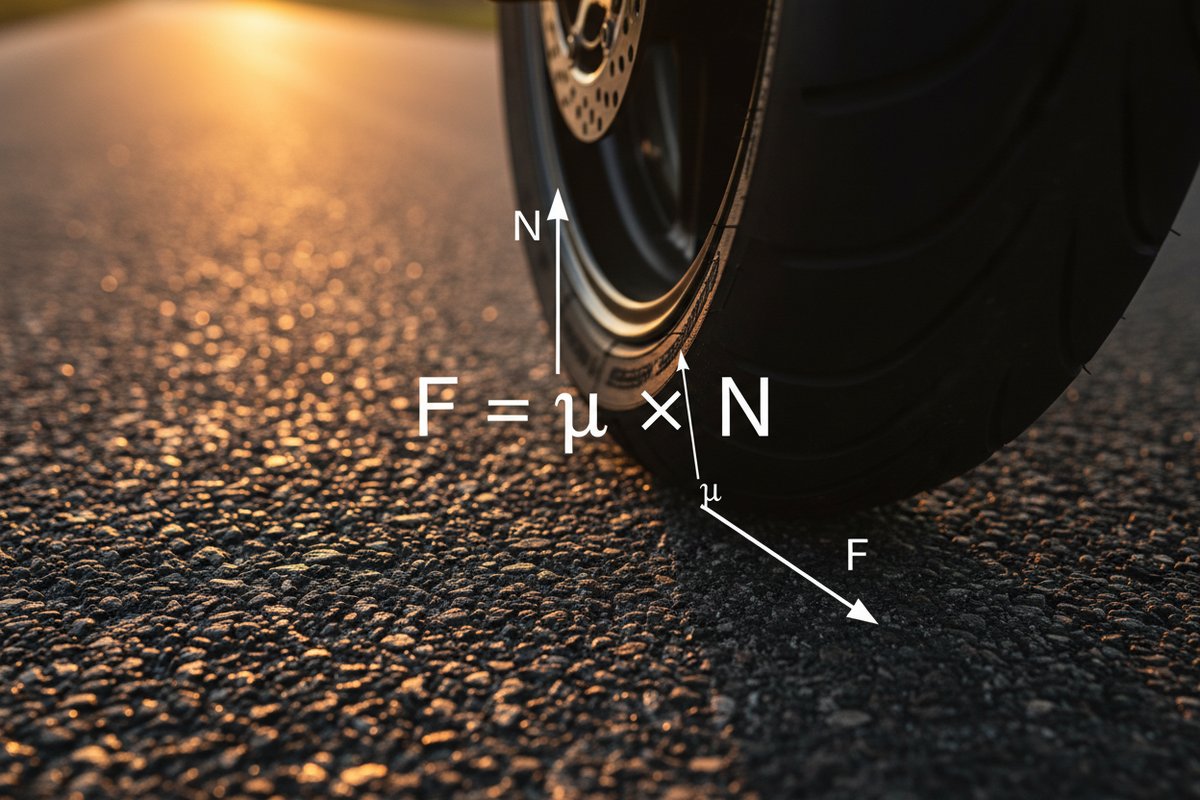
A tire that bounces uncontrollably doesn't just lose comfort. It loses contact.
The moment the tire bounces and separates from the asphalt — even if only for milliseconds — traction drops to zero. Braking is interrupted. Steering no longer receives reliable information. The ABS system, if present, receives a lock signal that does not correspond to actual braking and acts accordingly.
Every bounce is a break in the contract between the tire and the asphalt. And that contract, in motorcycle dynamics, is everything.
The adjustment that can be made and the one that cannot
The usual response to an excessively bouncing motorcycle is to increase shock absorber pressure, tighten the spring, or increase preload. In some cases, this helps. It reduces chassis movement, makes the motorcycle feel firmer, and can lessen the perception of bouncing.
But it doesn't address the root of the problem. A harder shock absorber doesn't change the tire's natural frequency. It doesn't control how it releases its energy. It doesn't prevent it from separating from the asphalt in high-frequency impacts.
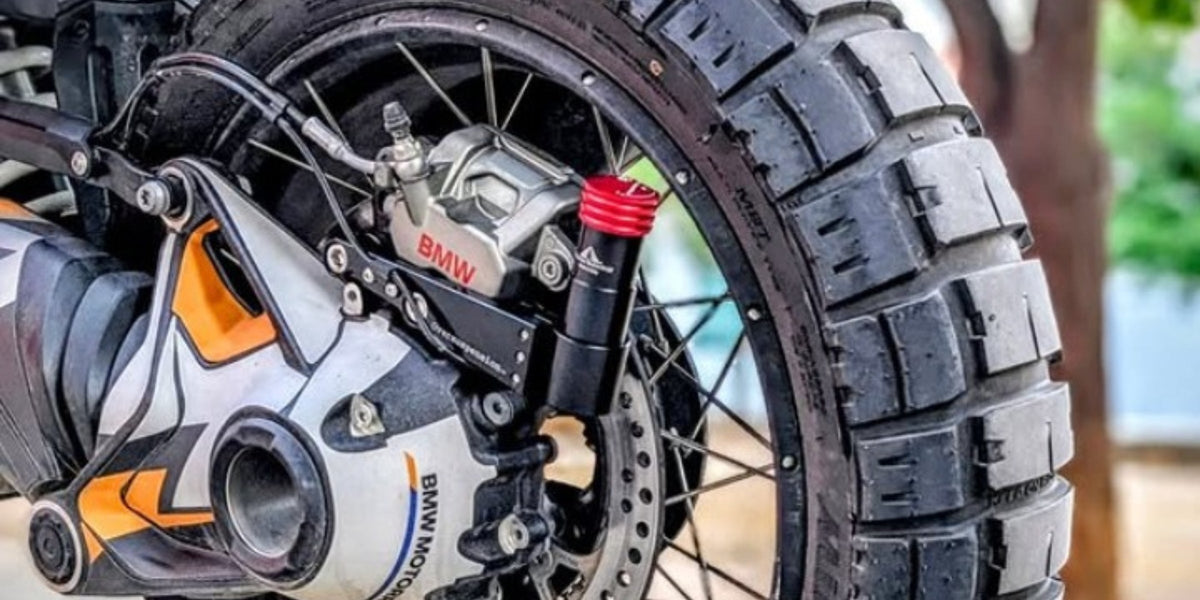
What can act at that frequency is an element that operates within the same range in which the tire generates its oscillations. That responds at 18 cycles per second, not 1.2. That is located at the end of the swingarm, where relative movement is maximum and the capacity for intervention is direct.
Tire bounce is not simply a problem of poorly adjusted suspension. It is the result of an uncontrolled elastic system, and it needs a control element that acts at the tire's own frequency.
The shock absorber does not solve tire bounce. Controlling the tire at its own frequency does.
→ FIND THE KIT FOR YOUR MOTORCYCLE HERE