
My motorcycle vibrates when accelerating and I've already checked everything: the cause no one tells you
Your motorcycle vibrates when accelerating, and you've already done what everyone says. You balanced the wheels. You checked chain tension and alignment. You verified the engine mounts and tightened the bolts. You checked that the rim wasn't bent.
And it's still vibrating.
If this is your case, this article is for you. Because the problem may not be in any of those places.
Conventional causes: rule out the obvious first
First of all, let’s be fair: most vibrations under acceleration have an identifiable mechanical cause, and you have to rule that out. An unbalanced wheel generates a rhythmic vibration that appears at a certain speed. A worn chain kit or an improperly tensioned chain transmits jerks when accelerating. Worn engine mounts let the engine block dance in its cradle. A dented rim or a tire with a flat spot vibrates above a certain speed.
All of that is real and all of that is fixed in a workshop. If you haven't checked these points, start there. But if you have already checked them—and many motorcyclists arrive here after having done so—there is a cause that almost no one mentions.
The vibration that doesn't appear in conventional diagnostics
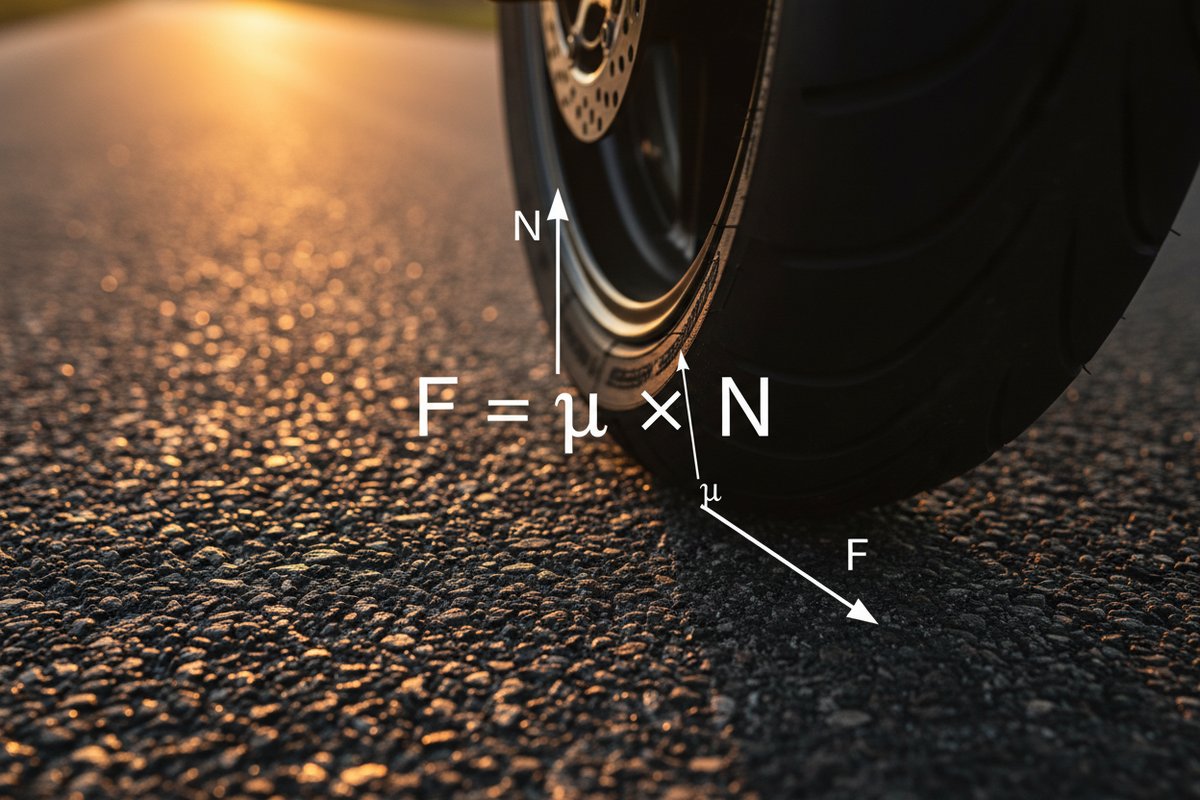
Your tire is not a rigid element. It is an elastic casing filled with compressed air: in practice, a spring. And like any spring, when it is compressed against an irregularity in the asphalt, it bounces.
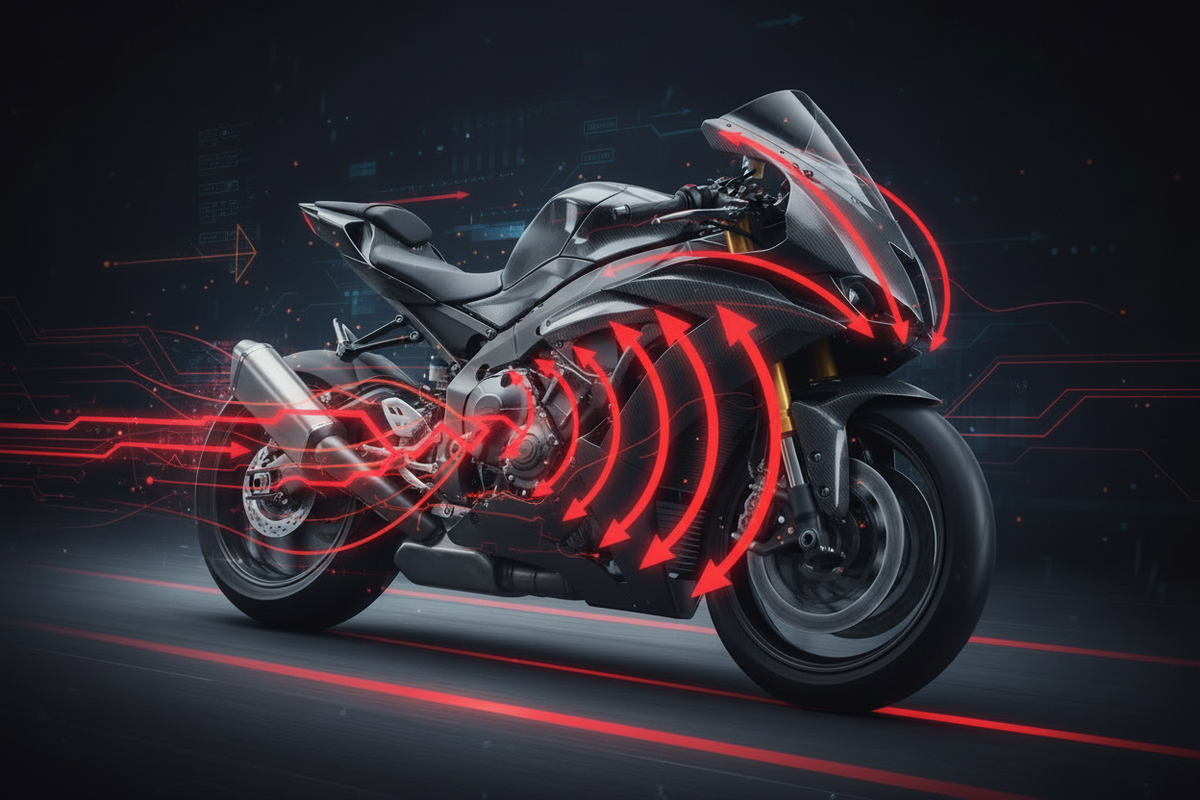
That bounce generates its own vibration—one that does not depend on the balancing, nor the chain, nor the mounts. It originates in the tire itself, in its contact with the ground, and travels up through the drivetrain to the handlebars and footpegs. We explain it in detail here.
What makes it especially elusive in diagnosis is that it is not constant: it appears more on degraded asphalt, during acceleration—when the rear tire receives more load—and while the rubber is still cold. That is why you notice it one day and not the next, and why the mechanic can't reproduce it on the test stand: it depends on the actual terrain you are riding on.
Why the suspension doesn't filter it out
The logical question is: what is the suspension there for, then? The suspension filters out many vibrations, yes, but not this one. Tire bounce occurs in a frequency range much faster than a hydraulic shock absorber can follow. It works on different time scales: by the time the suspension reacts, the vibration has already reached your hands.
How to know if this is your vibration
It is not a definitive diagnosis, but there are signs. If the vibration appears or worsens under acceleration on bumpy asphalt, if it is felt more in the first few kilometers while the rubber is cold, if it is irregular—coming and going depending on the road surface—and if it persists after having ruled out balancing, chain, and mounts, it is very likely that you are dealing with tire bounce and not a conventional mechanical failure.
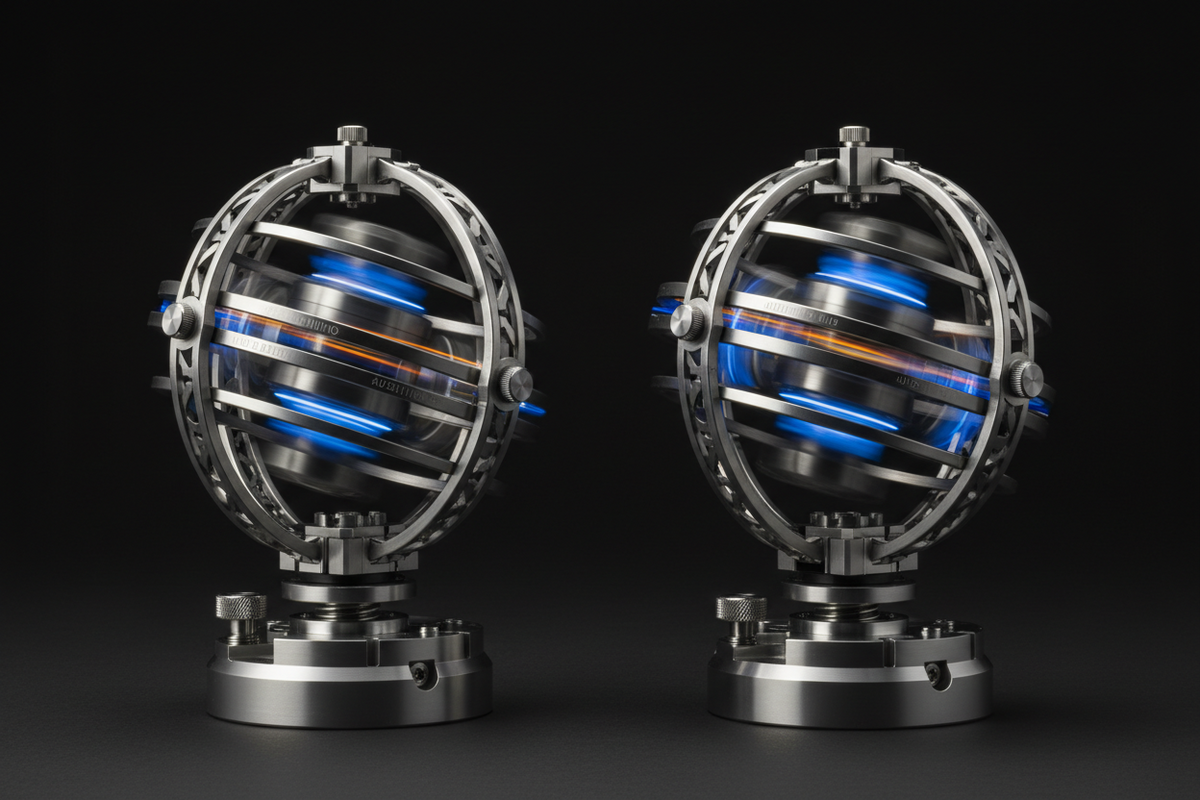
It cannot be fixed in the workshop with a torque wrench, because it is not a loose bolt or a worn part. It is tire physics. And it is corrected by acting exactly where it originates: by keeping the wheel in contact with the ground so that the bounce does not travel upward. That is what the Oversuspension Gravitational Resonator does: it counteracts the bounce the moment it is generated, before it turns into the vibration you feel in your hands.
If you have checked everything and your bike still vibrates when accelerating, perhaps you don't need another adjustment. Perhaps you need to manage the bounce that no adjustment touches. → FIND YOUR KIT