
That's for the track
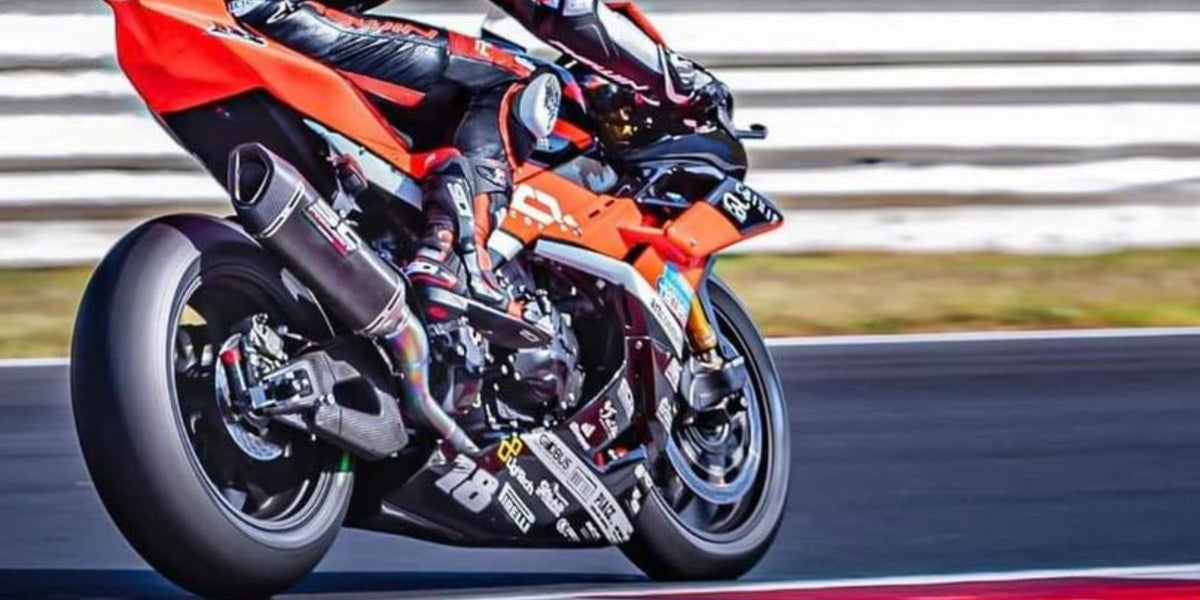
There's a prejudice that accompanies all technologies born in competition: "that's for the track; you wouldn't notice it on the street." With the Gravitational Resonator, this prejudice is based on seemingly logical reasoning—if MotoGP teams use it, it must be to shave off tenths that a street rider would never look for.
The reasoning fails in its premise. Tire bounce is not a track phenomenon. It's a tire phenomenon. And street tires work in worse conditions than track tires and are inferior tires.
The track is the easy scenario
Think about it the opposite way the prejudice suggests. A circuit has perfect asphalt, regularly repaved, no potholes, no gravel, no diesel spills, optimal tire temperature after two laps, and no traffic. It's the environment where tire bounce has the fewest excuses to appear—and yet it still does, and yet professional teams still install the device, because at those speeds even residual bounce costs tenths.
The road is the opposite: patches, expansion joints, truck ruts, gravel on the shoulder, rain, cold tires for the first fifteen minutes, variable load with a passenger and luggage. Per kilometer ridden, a street tire experiences more bounce events than a track tire—just at lower speeds and without a stopwatch to betray it.
What changes between versions is not the physics
The difference between installing the Resonator on the track or on the street is not whether it works, but what it gives back to you. On the track, it gives back time: continuous traction during acceleration from the apex, stability under braking, tenths. On the road, it gives back margin: the wheel sticking in a turn with unseen gravel, under braking on a patch, during an overtake on broken asphalt.
The track day rider buys performance. The street rider buys the same device and gets safety. It's the same physics at work; only what's at stake changes—and on the road, what's at stake isn't measured in tenths.
The definitive argument is given by the catalog
If the Resonator were a track accessory, the Oversuspension catalog would consist of ten superbikes.
There are over six hundred models: adventure bikes, scooters, customs, mid-range naked bikes, dirt bikes. Nicola Bragagnolo has always said it: this device should be installed on all motorcycles. Not as a stopwatch improvement. As an active safety feature.
The track validated it. The road is where it's needed.