

Entropy and the motorcycle
Entropy and motorcycles: why stability is a matter of system order.
In thermodynamics, entropy measures the degree of disorder of a system. Higher entropy means greater disorganization of the forces acting on it. Lower entropy means greater coherence between its elements.
A similar principle can be applied to motorcycle dynamics.
A moving motorcycle is a complete system composed of multiple elements in constant interaction: tires, suspension, chassis, rider's mass, inertial forces, and terrain irregularities. Each of these elements produces forces and responses that affect the rest. When they remain synchronized and coherent, the system has low entropy. When they fall out of sync and begin to generate cross-perturbations, entropy increases and the system becomes less predictable.
Greater entropy in a motorcycle means less stability, less predictability, and less control.
One often underestimated factor is the rider. Their mass, position, and physical inputs on the motorcycle actively contribute to reducing the overall entropy. The rider is not a passive passenger; they are a variable that brings coherence to the complete system. Motorcycle dynamics should therefore not be viewed as those of an isolated vehicle, but as those of a collective motorcycle-rider system where each element influences the behavior of the whole.
Within this system, the tire is the most significant source of entropy.
When the tire bounces uncontrollably, it generates forces of varying frequency and amplitude that propagate throughout the kinematic chain. Each unmanaged bounce introduces disorder into the system: it disturbs the suspension cycle, alters load transfer, and reduces the coherence of the whole. More bouncing equals more entropy. More entropy equals less control.
The inverse logic is equally precise.
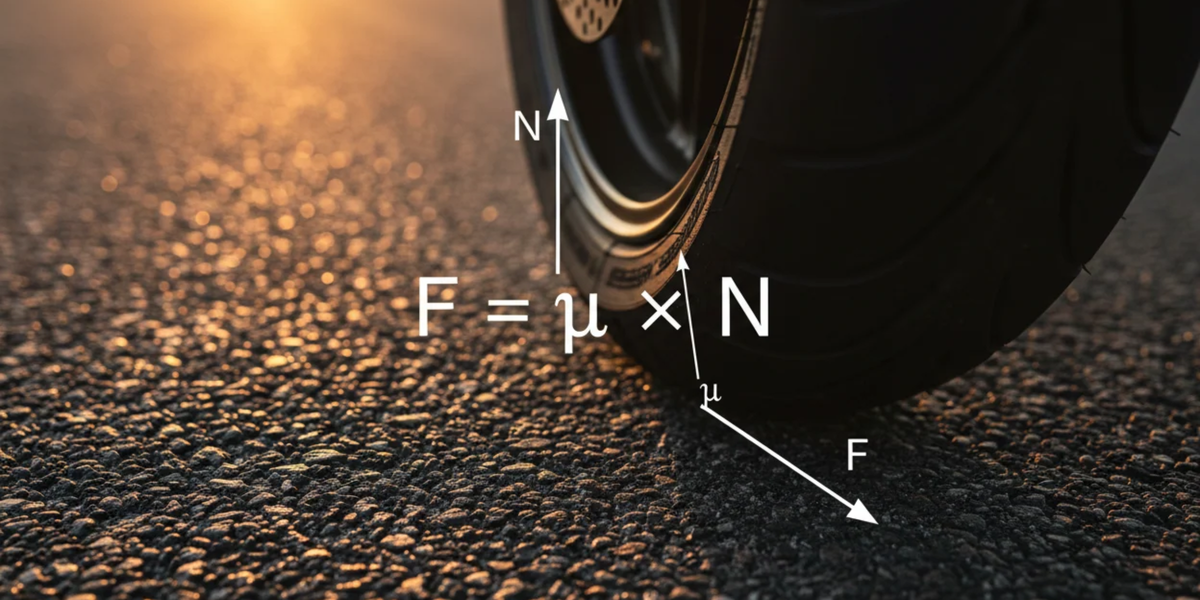
Reducing tire bounce is reducing the system's entropy. When the tire maintains consistent contact with the asphalt, the forces it generates are predictable and coherent. The suspension operates within its optimal range. The rider receives reliable information through the chassis. The complete system gains order, gains coherence, gains stability.
Oversuspension addresses this problem at its source. It doesn't act on an isolated component. It acts on the source of the system's entropy, reducing tire bounce in real-time and restoring coherence to the motorcycle-rider combination. Less disorder in the wheel means less disorder in everything above it.
Reducing tire entropy stabilizes the complete system.
It makes the motorcycle and rider function as a single, coherent unit.