
Same problem, on the other wheel
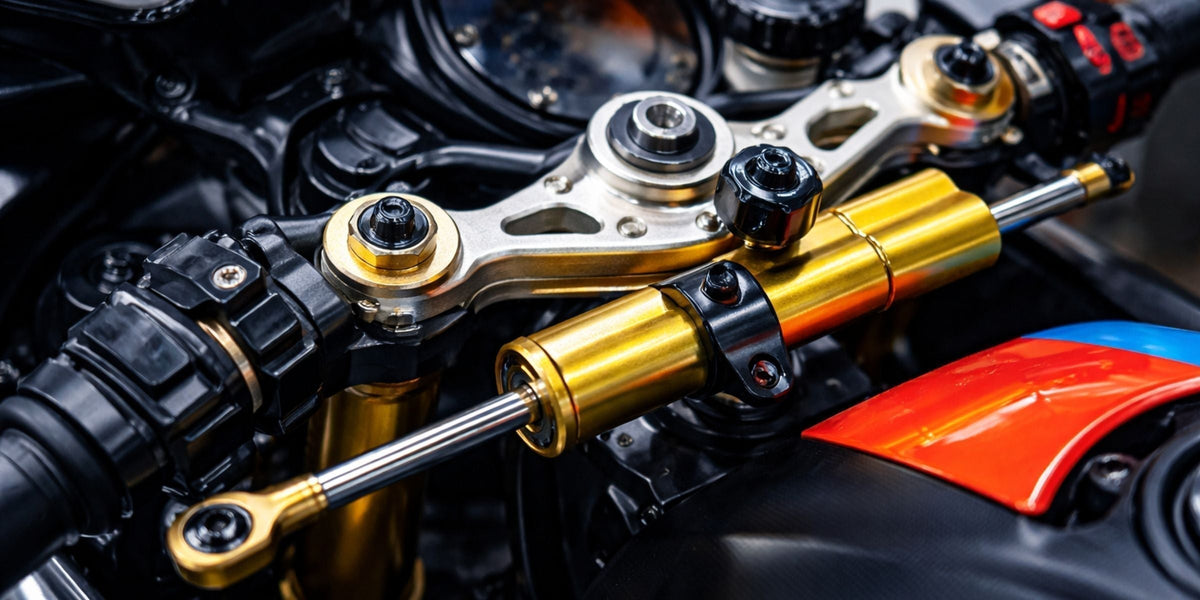
There's a device that no sport motorcyclist questions. It comes standard on almost all high-displacement motorcycles, it's mandatory in competition, and no one considers it an exotic accessory.
The steering damper.
Its history is instructive. It exists because the front end has a problem that the forks cannot solve: high-frequency handlebar oscillations — headshake, the dreaded wobble — occur too quickly for conventional suspension to manage them. The solution was not to improve the forks. It was to add a specific device, calibrated for that frequency range, that works in parallel with the suspension without replacing it.
Does that approach sound familiar?
The same problem, on the other wheel
The rear wheel has its own high-frequency oscillation that the suspension cannot manage: the elastic rebound of the tire. The same nature of the problem — a phenomenon faster than the working range of the main system — the same structural impossibility of solving it with a conventional shock absorber, no matter how good it is.
The difference is historical, not technical. Front headshake is violent, visible, and terrifying: it shakes the handlebars in the rider's hands. Rear rebound is silent: micro-lifts that aren't felt one by one. The front got its specific device decades ago because it was scary. The rear went without it because its damage is cumulative and invisible.
Until now.
Two devices, one same logic
The parallelism is direct, with a mechanistic difference worth clarifying. The steering damper is dissipative: it slows down handlebar oscillation by converting its energy into heat through a hydraulic circuit. The Gravitational Resonator goes a step further: it doesn't dissipate rebound; it counteracts it with an active, out-of-phase force that pushes the tire back to the ground.
But the underlying logic is the same that motorcyclists already accepted years ago for their front end: when a phenomenon occurs outside the suspension's range, the answer is not a better suspension. It's a specific device for that range.
No one asks a steering damper why its forks don't do that job. The correct question for the rear wheel is the same: it's not "why do I need another device?", but "why has my rear wheel been without its own for decades?".
The front end solved its high-frequency oscillation a long time ago. Now it's the rear's turn.