

The chattering that not even MotoGP can eliminate: why money doesn't solve tire resonance
There is a technical problem that appears season after season in MotoGP, which gives the highest-paid engineers on the planet a headache and which, with practically unlimited budgets, still has no definitive solution. It is called chattering. And understanding why the elite cannot eliminate it entirely says a lot about the nature of the problem—and about where the solution actually lies.
A problem that reappears every time something changes
Chattering is a resonance vibration that occurs mainly during braking and corner entry. The particular thing about it is that it is intermittent and fickle: a bike can be fine all weekend and start to "chatter" in a specific corner when the track temperature, tire compound, or setup changes. It has defined entire MotoGP seasons, and its reappearance usually coincides with a change in tires or specifications: a new compound that works wonders for one bike can trigger chattering in another.
Why money doesn't solve it
The answer lies in the nature of the phenomenon. Chattering is not a defective part to be replaced: it is a resonance, the coincidence between the frequency of a vibration and the natural frequency of the motorcycle assembly. And hundreds of components are involved in that equation at once—chassis, swingarm, suspension, tires, weight distribution, engine mounts.
That is why teams attack on all fronts: they change the stiffness of the chassis in certain areas, modify engine mounting points, adjust the length of the bike, test pressures and compounds, and add ballast to specific points on the swingarm. They are looking for a combination of frequencies that breaks the resonance. But since every corner of every circuit can generate its own chattering, there is no single adjustment that eliminates it everywhere. What works today does not work tomorrow. It is, in the words of the paddock itself, a permanent compromise.
The lesson for your street bike
If the best engineers in the world, with unlimited resources, do not completely eliminate tire resonance vibration, what does that tell you about your bike?
It tells you that it is not your fault, nor your suspension's, nor your tire's. It is a physical limit shared by all motorcycles in the world, from the MotoGP Desmosedici to your weekend adventure bike: the tire is a spring that bounces without anything to control it, and that bounce enters into resonance with the rest of the bike.
Attacking resonance at the source
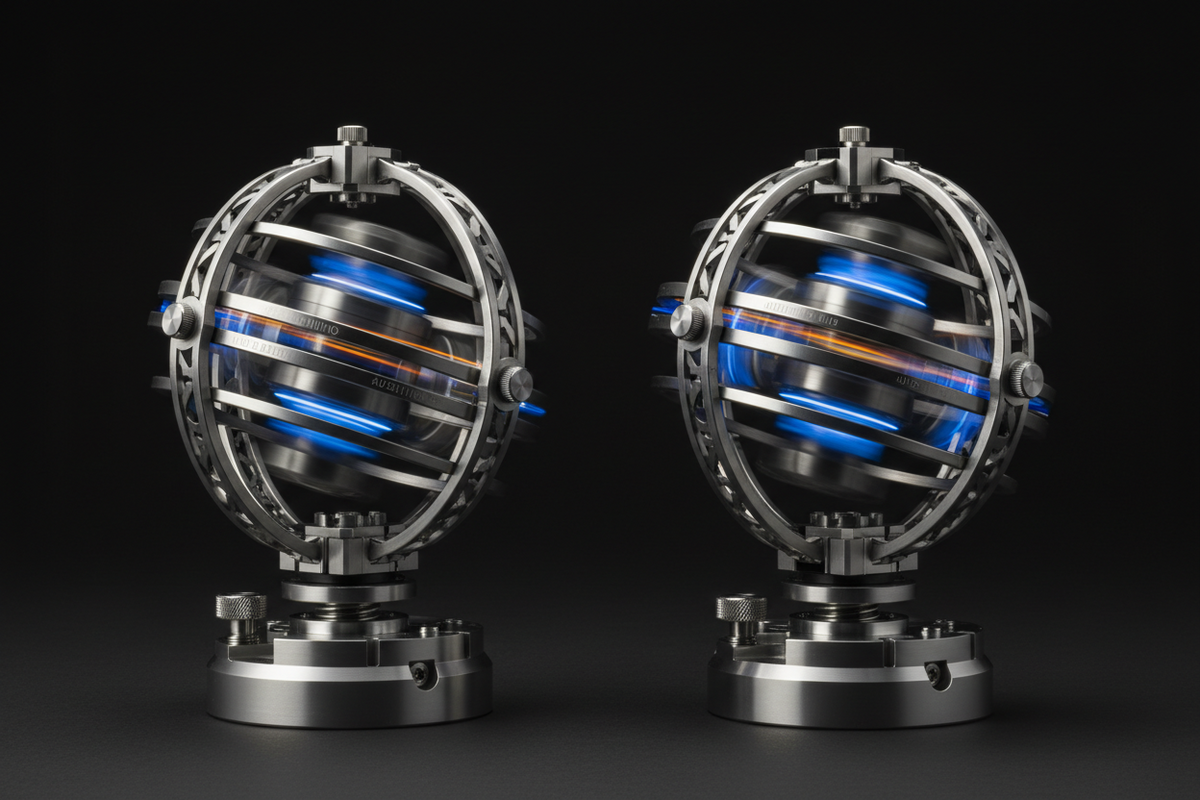
This is where the difference in approach lies. In racing, resonance is pursued by shifting the frequencies of dozens of components until, hopefully, they stop coinciding. The Oversuspension Gravitational Resonator attacks earlier: instead of reorganizing the entire assembly to avoid resonance, it acts on its source—the tire bounce—counteracting it the moment it is generated. Less bounce at the source means less energy available to enter into resonance with the rest of the bike.
Not even Ducati, with an unlimited budget, can completely eliminate tire resonance vibration by chasing it piece by piece. That is why it makes more sense to attack it where it is born.