
Wet curve
The Wet Corner: The moment ABS can't save you
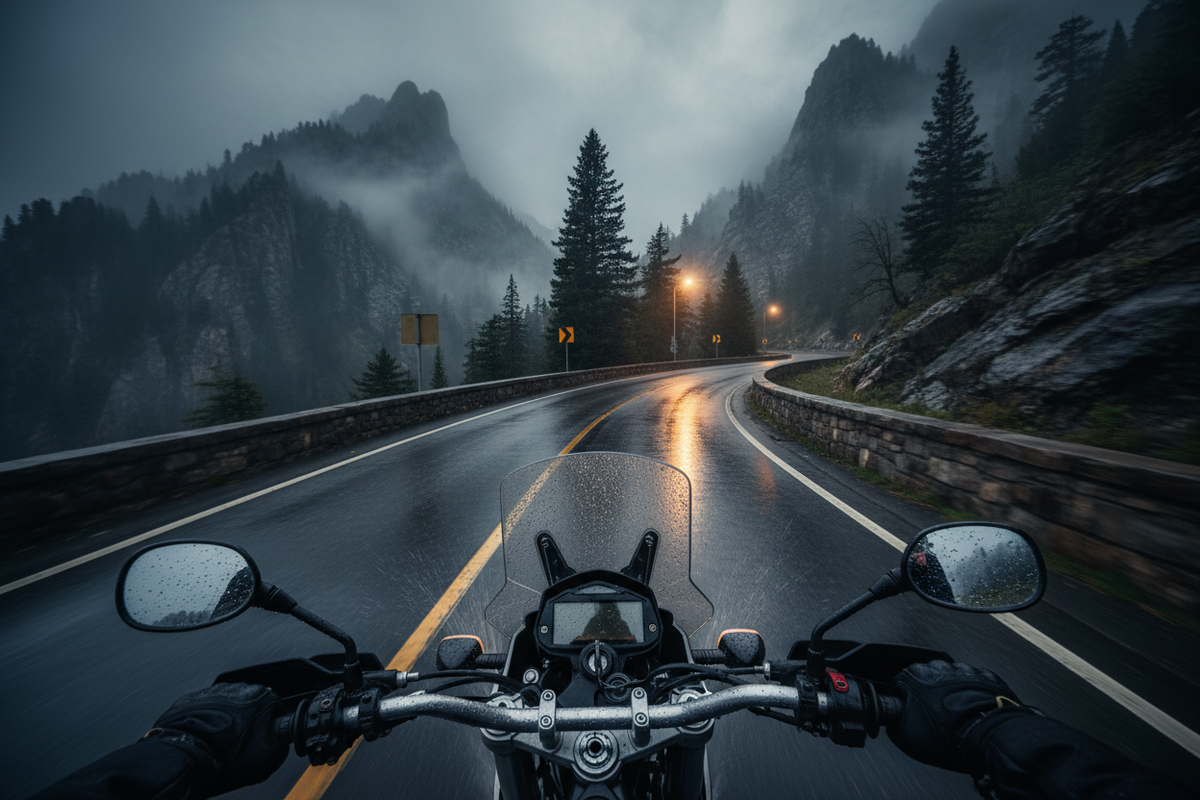
There's a scenario no street rider forgets: the mountain curve, the wet asphalt, the correct speed. You weren't going fast. You didn't make any obvious mistakes. And yet, for a fraction of a second, the bike stopped responding.
It wasn't aquaplaning. There was no sheet of water to displace. It was just wet asphalt, the bike leaned over, and something happened too fast to understand.
In a corner, the tire works with lateral grip. And lateral grip has an undeniable prerequisite: the rubber must be touching the ground.
Why a Corner is Different from a Straight Line
We've already talked about aquaplaning on this blog: the wedge of water the wheel lifts when the tread can't displace it. That's a problem of straight lines, speed, and water volume.
The wet corner is another phenomenon.
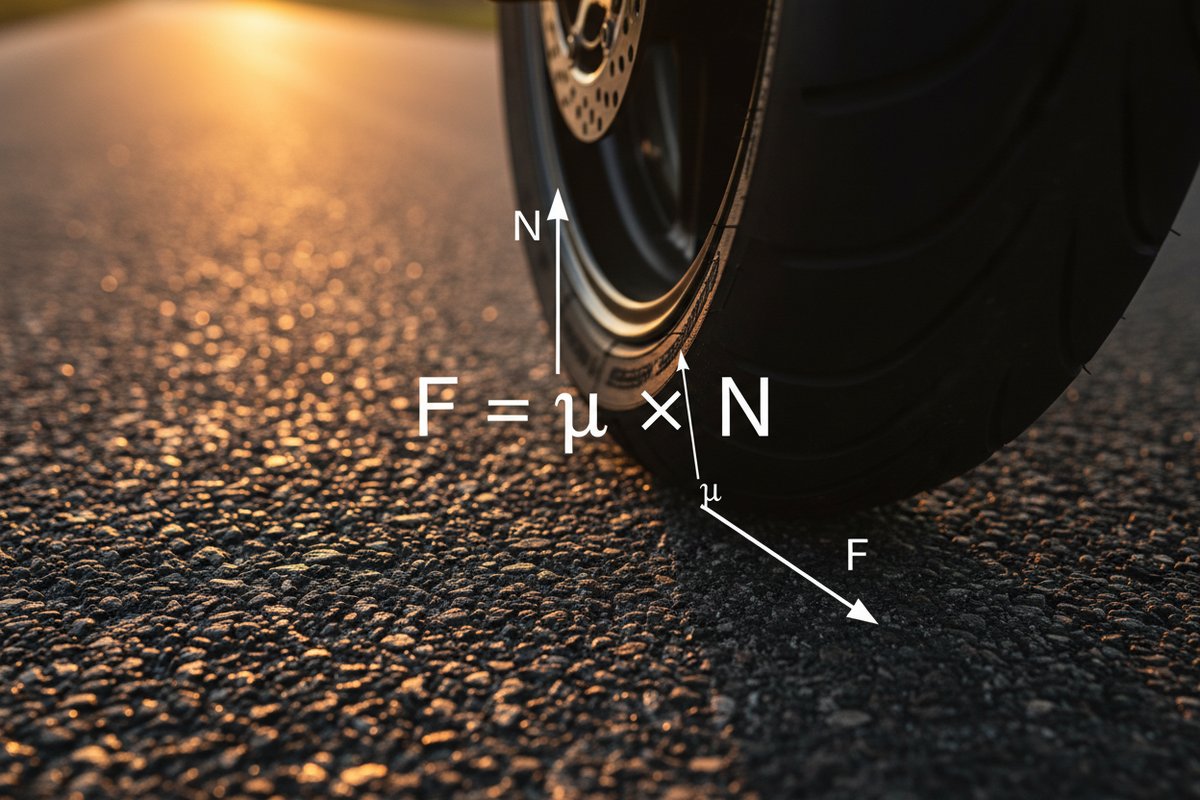
With the bike leaned, the weight no longer pushes the tire vertically against the asphalt. The force is distributed between supporting the bike and generating the lateral grip that keeps it on track. The available margin is reduced. And the water doesn't need to form a wedge: it just needs to reduce the coefficient of friction of asphalt that is already working near its limit.
In these conditions, tire bounce ceases to be an invisible phenomenon and becomes the trigger.
[Insurance] Every irregularity in the asphalt—a joint, a patch, a crack—causes the rubber to bounce. On a straight, dry road, these micro-lifts are absorbed without consequence. In a wet corner, every millisecond without contact is a millisecond without lateral grip. And without lateral grip, the bike doesn't fall to the ground: it goes off track.
What ABS can and cannot do
It's important to be precise here, because modern electronics are good and deserve to be discussed accurately.
[Insurance] Conventional ABS prevents wheel lock-up in straight-line braking. More advanced systems with an inertial platform —the so-called cornering ABS fitted on premium bikes— go further: they know how much the bike is leaned and modulate braking to avoid exceeding the available grip in a corner.
It's excellent technology. And all of it shares the same operating condition.
ABS, conventional or cornering, acts on the wheel. Not on the contact of the wheel with the ground. If the tire is in the air, there is no brake pressure to modulate or grip to manage. The most sophisticated system on the market cannot manage grip that does not exist.
Tire bounce occurs before and below the entire electronic chain. When the rubber detaches, the sensors register the consequences —the variation in rotation speed, the slip— but there is nothing left to correct: correction requires contact, and contact is precisely what has been lost.
Act before electronics are needed
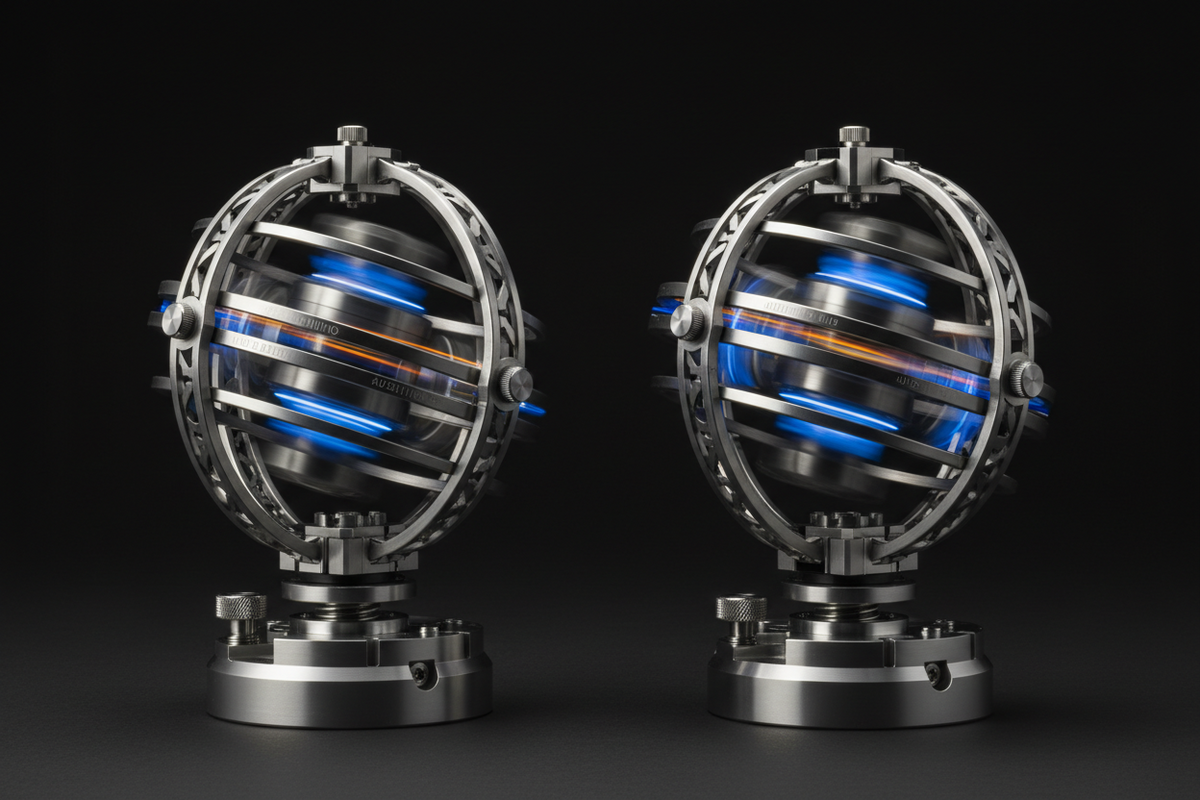
The Oversuspension Gravitational Resonator does not compete with ABS or traction control. It works at the earlier stage: ensuring that these systems have something to act upon.
When the tire tends to bounce over an irregularity in the middle of a corner, the Resonator generates its force in counter-phase, pushing the rubber back onto the asphalt the very instant the lift-off begins. Contact is maintained. Lateral grip still exists. And all of the bike's electronics retain the information and the ability to intervene if necessary.
Most of the time, maintaining contact means the electronics never even activate. Not because they don't work, but because the problem that would have activated them never occurred.
The wet corner will still be there
You can't control the rain, or the condition of the asphalt on a mountain road, or the expansion joint that appears in the middle of the line.
What you can control is how many doors you leave open to chance. The right tire, the correct pressure, prudent speed. And the tire's contact with the asphalt guaranteed on a timescale where neither you nor the electronics can intervene.
In a wet corner, it's not the one with the most electronics that wins. It's the one who never loses ground. → FIND YOUR KIT