
Your tire's bounce
The origin of the problem: air, rubber, and uncontrolled physics
To understand why the tire bounces, we need to go back to the beginning. To its components and the physical laws that govern them.
A tire is essentially two things: an elastic containment element — the rubber casing — and a compressible element that fills it — the air. Two materials with very different physical properties that work together to support the weight of the motorcycle, transmit traction, and absorb irregularities in the terrain.
The problem comes from the nature of the second element.
Air does not want to be compressed
The air enclosed within a tire is subjected to pressure greater than atmospheric pressure. It is compressed. And compressed gas has an undeniable physical tendency: to expand.
It's not a design flaw. It's basic thermodynamics. A gas confined under pressure stores potential energy and constantly tends to release it, to occupy more volume, to return to its equilibrium state. The rubber casing contains it, holds it back, forces it to stay inside. But the tension is always there.
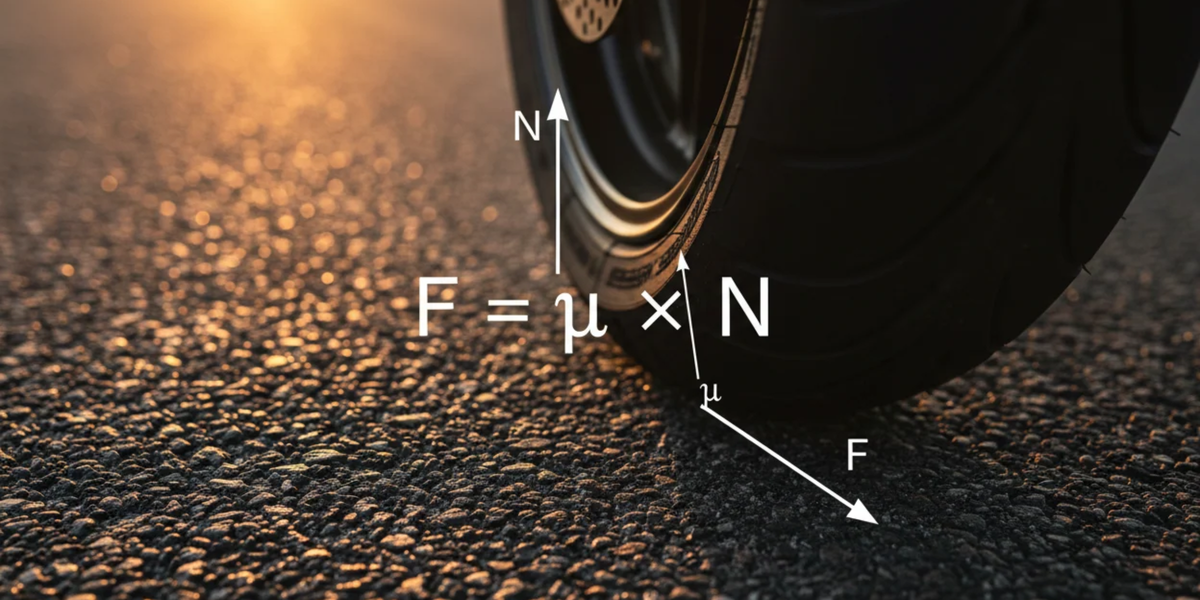
When the tire impacts an irregularity in the terrain — a pothole, a crack, a sudden change in profile — the casing deforms under the load. The internal volume changes. The pressure varies. And the instant the load ceases, the compressed air does the only thing it knows how to do: it pushes outwards with all the accumulated energy.
The elastic casing responds to that push. It expands. It bounces.
An uncontrolled bounce
And here's the core of the problem.
The tire's bounce is not regulated by any internal control element. The air expands because physics allows it. The rubber bounces because the air forces it to. There is no damping in this process. There is no management of the released energy. There is no mechanism within the tire that modulates the speed or amplitude of the bounce.
The tire bounces freely. With all the energy that the compressed air accumulates in each impact. And that energy has to go somewhere: it turns into vibration, into uncontrolled vertical force, into momentary liftoff of the wheel from the asphalt.
Thousands of times per kilometer. In every bump. In every crack. In every imperfection of the pavement.
The suspension tries to manage it. It partially succeeds. But the bounce happens in such a short time interval that conventional suspension is always too late. By the time the mechanical system responds, the tire has already bounced, has already lost contact with the asphalt, has already generated anomalous forces that propagate throughout the entire kinematic chain.
What Oversuspension changes in this equation
The Gravitational Resonator acts in the same time interval in which the bounce occurs. Not afterwards. Not when the suspension has already registered the movement. But at the instant the compressed air begins to expand and the casing tends to lift off the asphalt.
It generates a counter-phase response that counteracts the air's expansion force. It pushes the tire downwards with the same intensity that the air tries to push it upwards.
The air remains compressible. The rubber remains elastic. Physics does not change.
What changes is that now there is an active system that responds to that physics in real time. It converts an uncontrolled bounce into a managed movement. It keeps the tire where it needs to be: glued to the asphalt, in permanent contact with the only element that can give you control over your motorcycle.
The problem has been the same for decades. Oversuspension is the first solution that acts at the same speed. →FIND YOUR KIT